Dugdhapheni: Unterschied zwischen den Versionen
Aus Yogawiki
| Zeile 24: | Zeile 24: | ||
https://upload.wikimedia.org/wikipedia/commons/thumb/1/1a/Fr%C3%BChling_bl%C3%BChender_L%C3%B6wenzahn.jpg/330px-Fr%C3%BChling_bl%C3%BChender_L%C3%B6wenzahn.jpg | https://upload.wikimedia.org/wikipedia/commons/thumb/1/1a/Fr%C3%BChling_bl%C3%BChender_L%C3%B6wenzahn.jpg/330px-Fr%C3%BChling_bl%C3%BChender_L%C3%B6wenzahn.jpg | ||
https://upload.wikimedia.org/wikipedia/commons/thumb/e/ee/Smetanka_l%C3%A9ka%C5%99sk%C3%A1.JPG/360px-Smetanka_l%C3%A9ka%C5%99sk%C3%A1.JPG | https://upload.wikimedia.org/wikipedia/commons/thumb/e/ee/Smetanka_l%C3%A9ka%C5%99sk%C3%A1.JPG/360px-Smetanka_l%C3%A9ka%C5%99sk%C3%A1.JPG | ||
https://upload.wikimedia.org/wikipedia/commons/thumb/5/53/Gew%C3%B6hnlicher_L%C3%B6wenzahn_Taraxacum_officinale_agg._big.jpg/330px-Gew%C3%B6hnlicher_L%C3%B6wenzahn_Taraxacum_officinale_agg._big.jpg | https://upload.wikimedia.org/wikipedia/commons/thumb/5/53/Gew%C3%B6hnlicher_L%C3%B6wenzahn_Taraxacum_officinale_agg._big.jpg/330px-Gew%C3%B6hnlicher_L%C3%B6wenzahn_Taraxacum_officinale_agg._big.jpg | ||
https://upload.wikimedia.org/wikipedia/commons/thumb/8/82/Taraxacum_officinalis_DSC02042.JPG/375px-Taraxacum_officinalis_DSC02042.JPG | https://upload.wikimedia.org/wikipedia/commons/thumb/8/82/Taraxacum_officinalis_DSC02042.JPG/375px-Taraxacum_officinalis_DSC02042.JPG | ||
https://upload.wikimedia.org/wikipedia/commons/thumb/8/84/Kiaulpienes_ziedai.JPG/390px-Kiaulpienes_ziedai.JPG | https://upload.wikimedia.org/wikipedia/commons/thumb/8/84/Kiaulpienes_ziedai.JPG/390px-Kiaulpienes_ziedai.JPG | ||
Im Mai blüht der Löwenzahn, der daher auch "Maiblume" heißt. | |||
https://upload.wikimedia.org/wikipedia/commons/thumb/4/41/Pampeliskova_louka_2.jpg/330px-Pampeliskova_louka_2.jpg | https://upload.wikimedia.org/wikipedia/commons/thumb/4/41/Pampeliskova_louka_2.jpg/330px-Pampeliskova_louka_2.jpg | ||
Version vom 20. März 2025, 11:21 Uhr

Dugdhapheni (Sanskrit: दुग्धफेनी dugdha-phenī f.) eine Heilpflanze aus der Familie der Korbblütler (Asteraceae): Löwenzahn (Taraxacum officinale).
Namen und Synonyme
- deutsche Namen: Löwenzahn, Gemeiner Löwenzahn, Gewöhnlicher Löwenzahn, Ackerzichorie, Butterblume, Kettenblume, Kuhblume, Maiblume, Pfaffendistel, Pfaffenöhrlein, Pferdeblume, Pusteblume, Ringelblume, Wiesenlattich
- englische Namen: dandelion, common dandelion
- lateinische Namen: Taraxacum officinale, Taraxacum dens leonis, Taraxacum vulgare, Leodonton officinale, Leodonton taraxacum
- Nepali: टुकी फूल ṭukī phūl
- Malayalam: ദുഗ്ധഫേനി dugdhaphēni
- Sanskrit: Dugdhapheni, Payahpheni, Phenadugdha, Payasvini, Lutari, Vranaketu, Gojaparni
Bilder


Im Mai blüht der Löwenzahn, der daher auch "Maiblume" heißt.

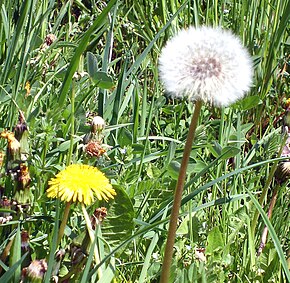

Der verblühte Löwenzahn ist allgemein als "Pusteblume" bekannt.

"Unkraut" oder Heilpflanze?
Siehe auch
Seminare
Sanskrit und Devanagari
- 06.01.2027 - 15.12.2027 Jahresgruppe Sanskrit - Lektüre der AMRITA SIDDHI 2 - online
Termine: 16x mittwochs: 06.01., 27.01., 17.02., 10.03., 31.03., 21.04., 12.05., 02.06., 23.06., 14.07., 08.09., 29.09., 20.10., 10.11., 01.12., 15.12.20…- Dr phil Oliver Hahn
- 09.04.2027 - 11.04.2027 Sanskrit Intensivwochenende
Du bist fasziniert vom Klang des Sanskrit und der tiefgehenden Wirkung der Wörter dieser uralten Sprache? Hast bereits Übersetzungen von Mantras oder …- Dr phil Oliver Hahn
Tsa Lung - Tibetischer Yoga
- In diesem Workshop erlernen und praktizieren wir eine Serie von fünf energetisierenden Übungen, die mit Körper, Aufmerksamkeit und Atmung arbeiten …
- Dr phil Oliver Hahn
